
How Much Does Brick Pointing Cost in NYC?
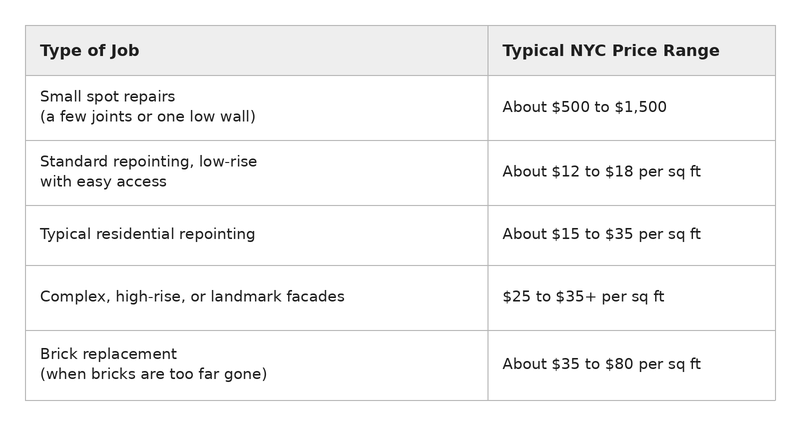
In 2026, most New York City property owners pay somewhere between $15 and $35 per square foot for professional brick pointing. A small patch job on a single wall can come in under $1,500, a typical Brooklyn rowhouse facade often lands between $5,000 and $12,000, and a full brownstone or apartment building facade can easily climb past $20,000. Where you fall in that range comes down to three things: how high the work goes, how much scaffolding it needs, and whether city rules like Local Law 11 or landmark requirements apply to your building.
Here's a closer look at the numbers and what's behind them.
Average Brick Pointing Costs in NYC
Cost per Square Foot
National cost guides tend to put repointing at roughly $8 to $15 per square foot, but those figures don't hold up in the five boroughs. Between union labor rates, insurance requirements, permits, and the simple hassle of working on a crowded city block, NYC masons typically quote $15 to $35 per square foot for standard residential work. Low-rise buildings with easy access sit at the bottom of that range, while landmark properties, complex facades, and taller buildings push toward the top and sometimes beyond it.
Cost by Building Type
Because every facade is a different size, it helps to think in project totals too. Contractors working in Brooklyn commonly price a single facade on a two-story brick rowhouse at around $5,000 to $12,000.
-
A three-story brownstone that needs the front plus a side wall often runs $10,000 to $25,000.
-
For a larger brownstone facade of around 2,500 square feet, full repointing can reach $18,000 to $42,000 depending on height, condition, and rigging.
Once you get into buildings over six stories, costs are usually quoted per project rather than per square foot, since sidewalk sheds, engineering reports, and filings become a big part of the bill.
What Drives the Price Up or Down
Following are some of the common factors that drive the costs.
Building Height and Access
Height is the biggest swing factor in NYC. Ground-floor work goes quickly, but anything above the second story usually means pipe scaffolding, a lift, or a hanging platform. Local contractors estimate that scaffolding alone can eat up 20 to 30 percent of a pointing budget, and it's not unusual for a parapet repoint at the top of a four-story brownstone to cost several times more than the same square footage at street level. If a sidewalk shed is required, expect it to be priced by the linear foot, with fully installed sheds often landing around $130 to $180 per foot for the first month, plus ongoing monthly rental.
Mortar and Brick Condition
Pointing is only affordable when the bricks themselves are still sound. If your mason finds cracked, spalled, or loose bricks, those need to be replaced, and replacement costs far more than pointing. Deep joint erosion, water damage behind the wall, or a previous bad repair also adds hours of prep before any fresh mortar goes in. A quick way to gauge your wall is to scrape a joint with a key. Healthy mortar resists, while failing mortar crumbles into sand.
Mortar Type and Color Matching
The right mortar matters as much as the labor. Most repointing uses Type N mortar, and older buildings often need even softer, lime-rich mixes. Hard modern mortars can actually damage old brick over time. For historic homes, you may also pay for testing. A mortar composition analysis typically costs $300 to $500, and lab color matching runs about $150 to $325. It's a small line item that saves you from a patchy-looking facade.
NYC Rules That Affect Your Pointing Budget
Local Law 11 and FISP
If your building is taller than six stories, it falls under the Department of Buildings' Facade Inspection and Safety Program (FISP), formerly known as Local Law 11. Owners must hire a Qualified Exterior Wall Inspector to examine the exterior walls every five years and file a report with DOB. Conditions flagged as unsafe are expected to be repaired within 90 days of the filing, though DOB can grant extensions when owners are actively working on it. That means pointing on larger buildings is often tied to an inspector's report, an engineer's oversight, and a strict timeline, all of which add to the cost.
Landmark and Historic District Requirements
For buildings in a historic district or designated as individual landmarks, repointing needs a permit from the Landmarks Preservation Commission. According to the LPC's permit guidebook, new mortar must match the original in color and joint profile, and it must be weaker and more breathable than the historic brick. Old mortar generally has to be removed by hand with a chisel, with power tools allowed only in limited cases. Samples must be installed next to clean original mortar and approved before full work begins, and masonry work can only take place when temperatures stay at 45 degrees or higher for 72 hours. Individual landmarks needing a full repoint usually require a mortar analysis too. All of that means slower, more careful work, which is why landmark jobs sit at the high end of the price range.
Scaffold and Sidewalk Shed Permits
Per DOB rules, you need a permit before putting up any sidewalk shed, as well as for supported scaffolds taller than 40 feet. Sheds that extend into the public sidewalk also need a separate DOT permit. On top of that, residential jobs in NYC should be handled by a contractor with a Home Improvement Contractor license from the Department of Consumer and Worker Protection. Make sure your quote spells out who is pulling these permits and whether the fees are included.
How Long Brick Pointing Lasts
When it's done correctly with a compatible mortar, a professional pointing job generally holds up for 25 to 50 years, depending on how exposed your walls are to wind, rain, and salt air. Corner buildings and walls that face the weather tend to need attention sooner. Spread over that lifespan, the upfront cost is modest compared to what water getting into your walls, or a DOB facade violation, can end up costing you.
Smart Ways to Keep Costs in Check
The simplest way to save is to act early. Catching failing joints before bricks start to loosen keeps the job in pointing territory instead of rebuilding. If you already need scaffolding for a roof, cornice, or window project, bundle the pointing into the same job so you only pay for rigging once. Get at least three written quotes that break out labor, materials, scaffolding, and permits separately, since a lowball number often leaves out access costs. And be wary of any contractor who suggests a hard cement mortar or skips the sample on a landmark building, because redoing the work later will cost far more.
Get an Accurate Brick Pointing Quote with Fixor NYC
Every NYC building is different, so the only way to know your real cost is to have a professional take a close look. Fixora NYC helps property owners across the five boroughs assess mortar and brick condition, plan around scaffolding, DOB, and LPC requirements, and restore facades with the right mortar the first time. Whether you own a Brooklyn brownstone, a Queens rowhouse, or a mid-rise facing an FISP deadline, we'll give you a clear, itemized estimate with no surprises. Contact us today to get a free estimate and schedule your assessment.