
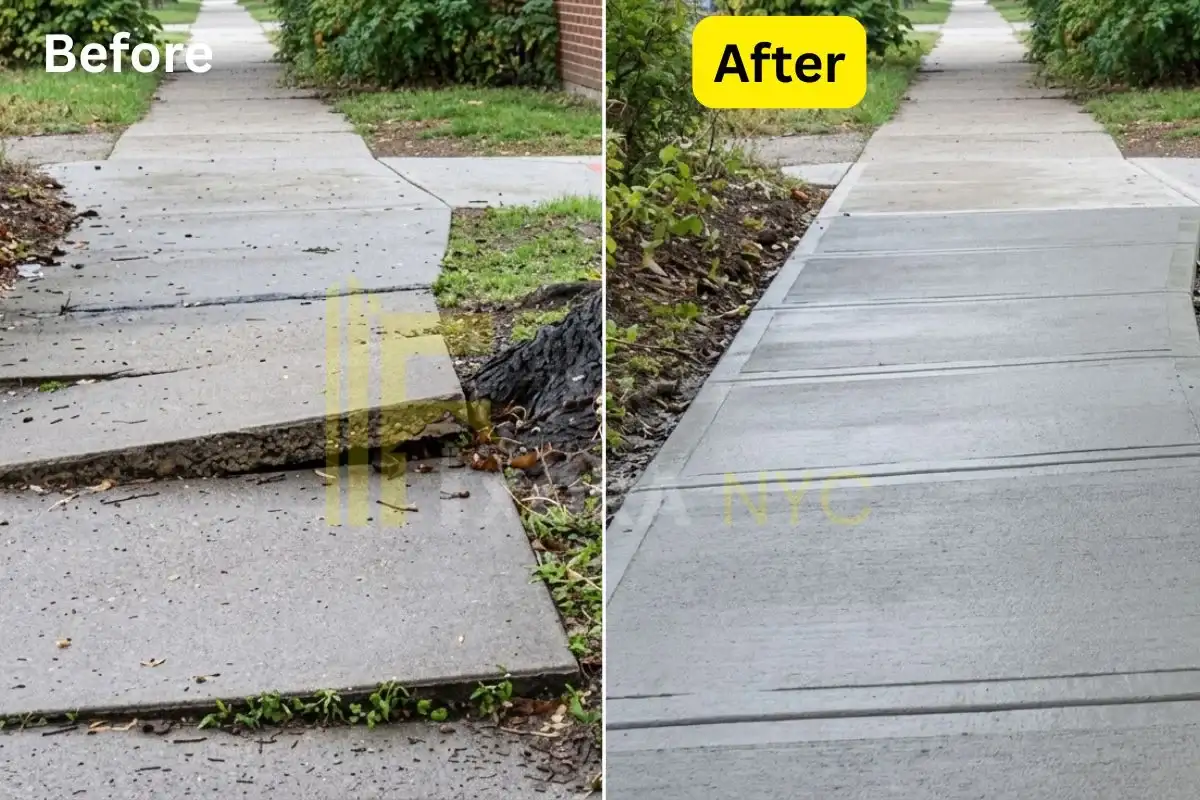
When Your Sidewalk Needs Professional Help: What to Expect
Got cracks or uneven sections in your sidewalk and not sure if it’s a real issue?
Don’t worry…
Sidewalk damage is one of the most common problems property owners deal with, especially in urban areas like New York. Some issues are minor and cosmetic. Others can signal deeper structural problems beneath the surface.
The good news is that catching these warning signs early can save you from costly repairs, city violations, and serious safety hazards.
In this guide, you’ll learn when sidewalk damage needs professional attention and what to expect from the inspection and repair process.
What Causes Sidewalk Damage?
Sidewalk cracks and uneven slabs don’t happen randomly. Something beneath or around the surface is always shifting over time.
NYC sidewalks face constant stress from foot traffic, weather changes, heavy loads, and nearby trees. One of the biggest contributors is tree root growth, which slowly pushes concrete upward and creates uneven surfaces.
Common causes of sidewalk damage include:
- Tree roots: Roots grow under slabs and lift or crack concrete over time
- Freeze-thaw cycles: Water seeps in, freezes, expands, and breaks the surface apart
- Soil movement: Natural settling or shifting ground creates uneven slabs
- Heavy loads: Vehicles or construction equipment can stress concrete not designed for it
- Poor installation: Weak base preparation leads to early cracking and sinking
- Water drainage issues: Standing water erodes the base beneath the sidewalk
- Aging concrete: Older sidewalks naturally weaken and deteriorate over time
In neighborhoods across NYC, sidewalk damage is especially common where mature street trees line the blocks. If your property has trees nearby, it’s worth paying extra attention.
When To Worry About Sidewalk Damage
Not every crack or uneven slab is an emergency.
Some issues are purely cosmetic, while others can become safety hazards or lead to city violations.
Hairline Cracks
These are small surface cracks and are usually not urgent. They are often caused by normal concrete shrinkage and aging.
Moderate Cracks or Slight Unevenness
When cracks widen or slabs start shifting almost ½ inch or more, it may indicate early structural movement. These should be monitored closely before they worsen.
Severe Cracks, Trip Hazards, or Sunken Slabs
This is where action is needed. Uneven slabs or lifted sections can become serious safety hazards and may even trigger DOT sidewalk violations in NYC.
Warning signs you should never ignore:
- Uneven or lifted sidewalk slabs
- Deep or widening cracks (½ inch or more
- Water pooling on concrete surfaces
- Gaps between slabs
- Trip hazards or raised edges
- Cracks spreading over time
- Sections sinking or tilting
The longer these issues are ignored, the more expensive and complicated the repair becomes.
What To Expect From A Professional Inspection
So you called Fixora NYC to check your sidewalk… Now what?
Our professional sidewalk specialists follow a structured process to understand what’s really happening beneath the surface.
Initial Visual Inspection
The first step is a full walkthrough of the property. The inspector will examine cracks, slab movement, and elevation changes. They may use measuring tools to assess trip hazards and level differences.
Site Evaluation
Next, they’ll look at surrounding conditions, including:
- Tree roots and nearby vegetation
- Drainage and water flow patterns
- Soil condition beneath the sidewalk
- Adjacent driveway or curb alignment
- Any visible signs of shifting or erosion
Structural Assessment (If Needed)
If the damage looks significant, further evaluation may be required to determine whether the base or subgrade has failed.
Report and Recommendations
After inspection, you’ll typically receive a clear breakdown of:
- What is causing the sidewalk damage
- How severe the issue is
- Whether repair or replacement is needed
- Estimated cost and timeline
A good thorough inspection by our reliable experts gives you complete clarity on what’s happening and what comes next.
How Sidewalk Damage Is Repaired
The repair method we choose depends on the severity and root cause of the problem. Some issues can be addressed with simple repairs, while others require removing and replacing entire sections of concrete. A proper inspection helps determine which solution will provide the safest and longest-lasting result.
Crack Sealing or Patching
Minor surface cracks can often be sealed or patched to prevent further water intrusion. This approach works best when the concrete is still structurally sound and the damage is limited to the surface. Sealing small cracks early helps stop moisture from reaching the base below, where freeze-thaw cycles can turn a minor issue into a much larger problem.
Patching is generally considered a maintenance solution rather than a permanent fix. It improves appearance, extends the life of the sidewalk, and helps delay more costly repairs down the road.
Slab Grinding or Leveling
If slabs are uneven but still structurally sound, grinding or leveling is used to reduce trip hazards. We use mudjacking or polyjacking techniques to raise settled sections and restore a smoother walking surface without removing the existing concrete.
Grinding is commonly used when one slab sits slightly higher than the adjacent section. For sunken slabs, leveling methods fill the void beneath the concrete and lift it back into place. These approaches are less invasive than replacement and can often be completed faster while minimizing disruption to pedestrians and property owners.
Concrete Replacement
When slabs are severely cracked, sunken, or lifted by tree roots, full replacement is usually required. Removing damaged sections allows us to address underlying problems before installing new concrete that meets local standards and provides a fresh, durable surface.
Partial replacement is often enough when the surrounding slabs remain in good condition. Replacing only the affected sections helps restore safety and maintain the overall appearance of the sidewalk without the need to rebuild the entire walkway.
Root-Related Repairs
In cases involving tree roots, repairs may also include root pruning or installing protective barriers to prevent future lifting. Since roots naturally seek moisture and space, simply replacing the concrete without addressing the underlying cause often leads to recurring damage.
Depending on the size and location of the tree, additional coordination with NYC Parks along with a certified arborist may be necessary, since tree root repair needs additional permits. Root barriers can help direct future growth away from the sidewalk, reducing the likelihood of new cracks and uneven slabs developing over time.
Full Sidewalk Installation
For widespread damage, complete removal and reinstallation of the sidewalk may be necessary to restore safety and compliance. Full reconstruction typically involves demolishing existing concrete, preparing and compacting the base, and pouring new slabs that meet current specifications.
Although this is the most extensive repair option, it also provides the longest-lasting results. Full reconstruction is often recommended when multiple slabs have failed, drainage issues are present, or years of patchwork repairs have left the sidewalk beyond practical restoration.
Sidewalk Repair Costs: What You Can Expect to Pay
You might be expected to pay for your sidewalk as little as $100 and as much as $10000. Sidewalk repair costs can vary widely depending on damage severity, site accessibility, the amount of concrete involved, and whether permits are required. Tree-related work, drainage corrections, and utility considerations can also affect the final price. Acting early almost always reduces total cost, as small defects are usually easier and less expensive to correct before they develop into major structural problems.
Here's the cost breakdown:
|
Types of Damage |
Repair Method |
Typical Cost Range |
Notes |
|
Hairline or Minor Surface Cracks |
Crack Sealing or Patching |
$150-$600 |
Suitable for small crack & cosmetic issue |
|
Slightly Uneven Sidewalk Slabs |
Grinding or Leveling |
$500-1500 |
Effective when concrete remains structurally sound |
|
Broken Slab |
Concrete Replacement |
$1000-$2500 |
Only cracked section removed and replaced |
|
Severe Structural Damage |
Full sidewalk Installation |
$5000-$7000 |
Include demolition, base prep, & pouring new concrete |
|
Drainage Problem Combined with Sidewalk Damage |
Full Sidewalk Replacement With Proper Drainage |
$7000-$10000 |
Involve grading and drainage system, along with fully concrete installation |
Actual costs vary based on the severity of the damage, sidewalk size, accessibility, local labor rates, permit requirements, and whether tree-related work or utility adjustments are involved. In cities like New York, repairs involving street trees may require permits and coordination with NYC Parks, which can increase overall project costs.
Conclusion
Sidewalk damage is common, but it should never be ignored. While hairline cracks are often cosmetic, uneven slabs should be monitored closely because they can worsen over time. Trip hazards deserve immediate attention, and tree roots remain one of the leading causes of sidewalk lifting and displacement. Addressing problems early not only helps prevent accidents but can also save property owners from costly repairs and potential violations later on.
If you notice anything unusual, it's wise to have the area inspected by your local sidewalk experts like Fixora NYC before a small defect turns into a much larger problem. Our skilled crew is here to provide a free onsite inspection along with an estimate. Give us a call now and let us make your sidewalk safe, accessible, and code-compliant.